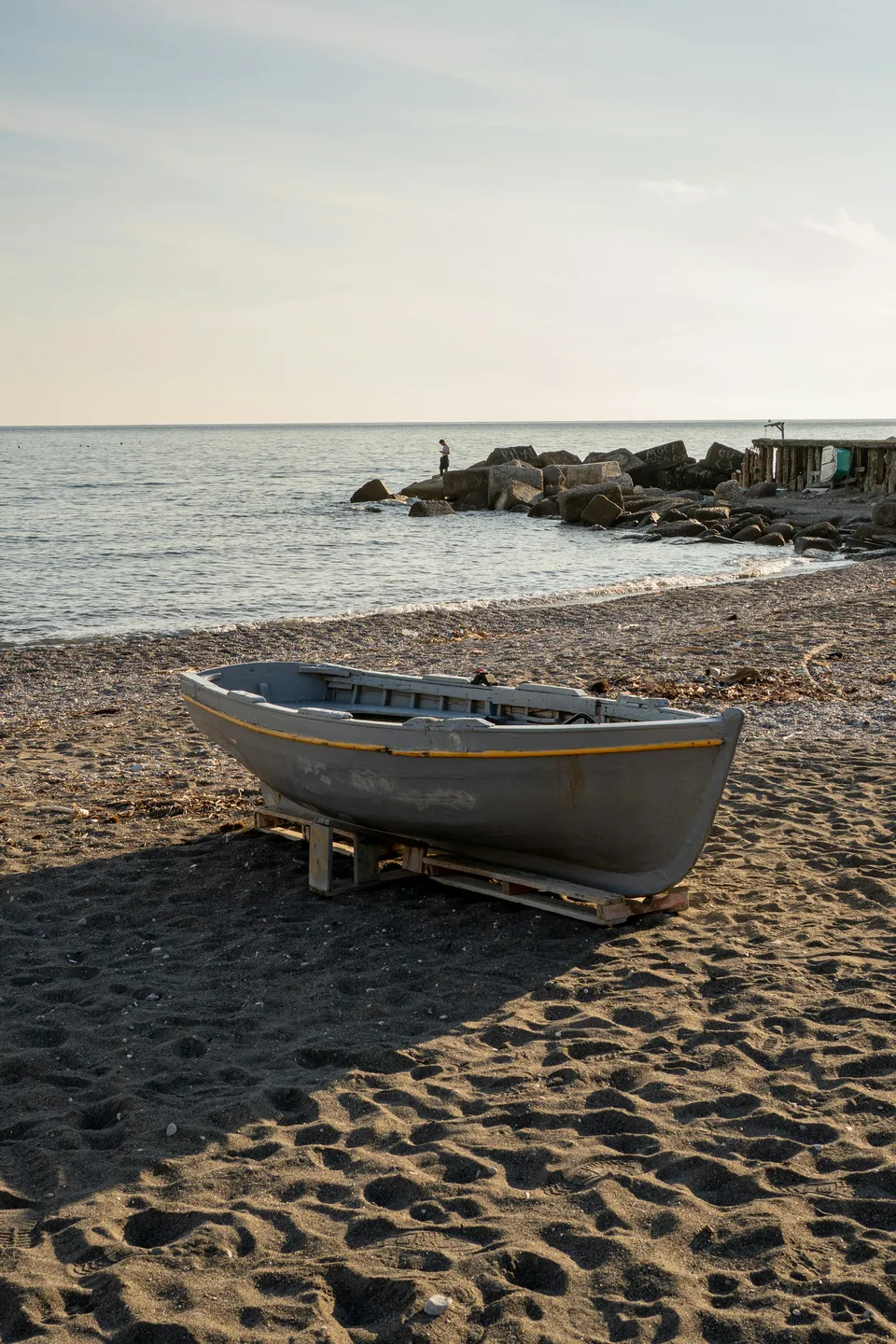
A town that speaks through majolica
In Vietri, ceramics are not confined to display cases. They appear on street-name plaques, on panels beside doorways, in facade decorations and even on the church of San Giovanni Battista, whose dome is covered in majolica.
For this reason, the best way to approach the subject is to walk with your eyes raised: the town itself is a small open-air gallery, and the workshops in the center are its natural extension.
The roots of an ancient tradition
Clay work in Vietri has distant origins and developed over the centuries thanks to a combination of factors: the availability of raw materials in the area, proximity to the sea and trade routes, and the presence of family-run workshops.
For a long time, the focus was mainly on everyday objects: dishes, jars, containers, floor and wall tiles. The craft and domestic dimension has remained a distinctive feature even as production became more artistic.
The years of the German ceramicists
A decisive chapter opened between the 1920s and 1930s, when artists and ceramicists from northern Europe, especially Germany, arrived in Vietri. Among the best-remembered names are Richard Dölker and Irene Kowaliska.
Their encounter with local masters brought a new language: simpler forms, stylized designs, and a decorative freedom that engaged with Mediterranean tradition. From that period comes much of the Vietri imagery we know today, with essential figures, animals, seascapes and rural scenes.
How a piece is made
The classic process follows precise steps:
- shaping the clay on the wheel or in a mold;
- the first firing, which turns the mixture into terracotta;
- applying the glaze, which makes the surface white and shiny;
- hand decoration with colored oxides;
- the second firing, which sets the colors.
The decoration is painted onto the raw glaze, so the brush allows no second thoughts. It is precisely this spontaneity that gives each piece small differences, which are the signature of the hand and not a defect.
Colors and motifs to recognize
The Vietri palette is bright and linked to the landscape: the yellow of lemons, the green of vegetation, the blue of the sea, the orange and brown of the earth.
Recurring subjects include fish, birds, cockerels, stylized human figures, fruit and floral or geometric motifs. Alongside the more traditional style, contemporary production also exists, with more abstract signs and experiments in form: it is worth comparing several workshops to catch these nuances.
Where to encounter ceramics, beyond the shops
The workshops in the center are the starting point, but the route can be extended. The majolica dome of San Giovanni Battista is a monumental example of the use of ceramics in architecture.
Architecture enthusiasts may look for the large ceramics factory designed by architect Paolo Soleri, a building that tells of the link between craft industry and formal research. For a complete historical reading, the Museum of Ceramics in the Torretta of Villa Guariglia, in Raito, collects and frames local production: we devote a separate article to it.
How to choose an authentic piece
A few precautions help you find your way without rushing:
- look at the back and the base, where the workshop mark or initials often appear;
- look at the brushwork: hand-painted strokes show slight variations in thickness and tone;
- ask for information about the making process and the origin of the piece; reputable workshops are happy to explain their method;
- consider its use: if an object is meant for the table, ask whether it is suitable for contact with food and for washing.
For fragile items, ask how they should be packed for travel, and if shipping is needed, inquire directly in the shop.
Practical tips for your visit
A leisurely walk along Corso Umberto I and the nearby streets allows you to go in and out of the workshops without pressure. Many studios let you glimpse the work of the wheel or the decorators: ask politely, as this is not always possible.
Opening hours, closing days and the availability of workshop visits vary with the seasons and may change: always check the official channels of the Comune, the museum or the individual workshops before planning your day.
Frequently asked questions
Why is Vietri ceramics so colorful?
The palette is inspired by the landscape and Mediterranean tradition: yellow, green, blue and orange are hand-painted with oxides on the glaze, then fixed with the second firing, which enhances their brilliance.
How can you tell if ceramics are hand-painted?
Look at the surface: small irregularities in the line and shading indicate brushwork. Also check the base, where the workshop mark is usually present, and ask the ceramist or shopkeeper directly for information.
Can you see where ceramics are made in Vietri?
Some workshops allow visitors to observe the making and decoration process, but not always and not in every season. To find out whether a workshop or the museum can be visited, it is best to check updated information from official sources.
Sources and useful links
Times, prices and services can change: always check with the official sources before you travel.
Updated: 2026-10-26